Skip to content
Open to SWE and AI Engineer roles, 2027 new grad and internships

I build AI systems that hold up in production.

AI / Founding Engineer·Applied AI · Agentic Systems · Full-Stack·production RAG at 99% retrieval recall

I am a founding engineer who builds retrieval and agentic AI systems end to end, from hybrid RAG and evaluation harnesses to the apps that sit on top of them. That work has shipped to more than 10,000 downloads, cut response latency by about 70%, and improved answer accuracy by 34.5%.

Press ⌘K to jump anywhere · ? for shortcuts

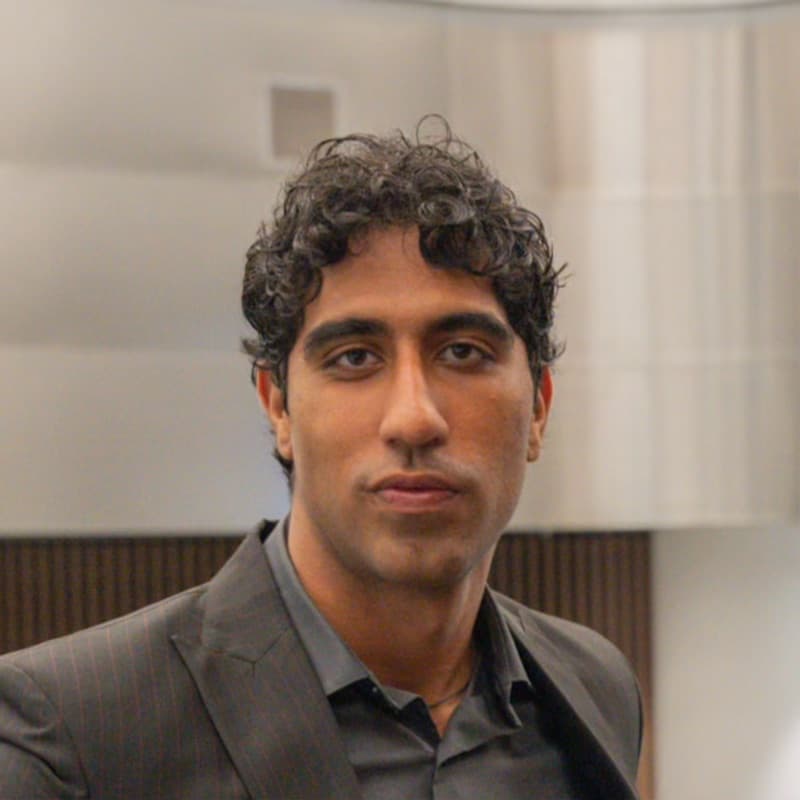
Javin Ahuja, headshot
College Park, MD
34.5%

RAG accuracy lift

Measured across 5,000+ real-world queries at Garden For Wildlife.

10,000+

Downloads shipped

+66% MoM on cross-platform releases I ship weekly.

35% → 55%

QA accuracy, fine-tuned

LoRA fine-tune of Qwen2.5-3B on lease clauses I extracted myself.

9s to 3s

Latency cut

Privacy-safe semantic cache at Peptide AI, about 70% faster on cache hits.

0+
Years building

Since 2023, across internships, research, and a founding role

0+
Projects shipped

Production apps, RAG systems, and ML research projects

0+
Technologies

Across AI, frontend, backend, data, and cloud

0K+
App downloads

Cross-platform releases shipped weekly at Peptide AI, +66% MoM

0K+
App Store impressions

Daily impressions, +850% growth

0%
Latency reduced

Semantic cache: 9s → under 3s on cache hits

TypeScriptPythonJavaScriptSQL (PostgreSQL, MySQL, SQLite)JavaCBashSwiftRAG (hybrid, hierarchical)Agentic systemsEvaluation frameworksPrompt engineeringAnthropic (Claude) APIOpenAI APILangChainFine-tuning (LoRA/SFT, Unsloth)RL fine-tuning (GRPO)Gemini APIReactReact NativeNext.jsCapacitorSwiftUISupabase Edge Functions (Deno)FastAPIFlaskNode.js / ExpressREST APIs / WebSocketSpring BootPostgreSQL (RLS, pg_cron)pgvectorFAISSPython data pipelinesMonte Carlo simulation

Experience

Five teams, and the same approach every time: ship it, then measure it.

Founding engineering, machine learning internships, and client work. Each entry expands if you want the specifics.

  1. PA

    AI / Founding Engineer

    Current

    Peptide AI · Remote · Founding

    May 2026 to Present

    Own the retrieval and agent stack behind the app's AI Chat, plus the cross-platform clients on top of it.

    10,000+ downloads (+66% MoM), 85K+ daily App Store impressions (+850%), 70% latency cut on cache hits.

    • Architected the production RAG system (TypeScript, Supabase Edge Functions/Deno) powering AI Chat: hybrid dense + BM25 retrieval, Voyage cross-encoder reranking, and streamed Claude (Anthropic API) responses grounded in each user's own data.
    • Built an agentic framework (TypeScript) that reasons over user data, wearable signals, and retrieved evidence to generate personalized, safety-aware recommendations.
    • Designing an agentic Coach system that separates deterministic stats computation from LLM narration, grounds claims in evidence-tiered RAG citations, and evaluates agent trajectories (claim-level grounding, tool-trace correctness, negative-control abstention) rather than final output alone.
    • Designed a privacy-safe semantic cache (TypeScript, pgvector) cutting response latency ~70% on cache hits (9s → under 3s) at $0 marginal cost, enforced by dedicated safety guards and a Deno regression suite.
    • Shipped cross-platform apps (React, React Native, Capacitor) weekly, driving 10,000+ downloads (+66% MoM) and 85K+ daily App Store impressions (+850%); leading a native Swift/SwiftUI rewrite.
    TypeScriptSupabase Edge FunctionsDenopgvectorAnthropic APIReactReact NativeCapacitorSwift/SwiftUI
  2. BA

    Backend Engineer

    Booz Allen Hamilton · App Dev Club · Remote · Client project

    Jan 2026 to May 2026

    Video-processing backend for structured document extraction from screen recordings.

    Cut redundant frame captures ~3x while keeping extraction resize-resilient.

    PythonFastAPIOpenCVDCT hashingSSIM
  3. UM

    Software Engineer

    UMD Smith Financial Wellness Team · College Park, MD · University

    Sep 2025 to Dec 2025

    End-to-end ownership of a financial planning app for the student body.

    Shipped to 5,000+ students, running 10,000+ Monte Carlo simulations.

    PythonFlaskReact NativeMonte CarloREST APIs
  4. GW

    Machine Learning Intern

    Garden For Wildlife · Remote · Internship

    Aug 2024 to Aug 2025

    Built and shipped the RAG pipeline behind customer-facing answers, then proved it worked at scale.

    34.5% accuracy improvement and 15% latency reduction across 5,000+ evaluated queries.

    PythonLangChainFAISSOpenAI APIETL
  5. DG

    Full Stack Engineer Intern

    DocuGuardian · Remote · Internship

    Dec 2024 to Jul 2025

    Secure document workflows across the stack, plus the CI that kept releases boring.

    Improved release stability 30% via CI/CD hardening and automated testing.

    Spring BootPostgreSQLTypeScriptReactCI/CD

Selected work

What I have built, and what the numbers actually were.

Featured work comes first. Every card opens an architecture diagram and a full case study covering the problem, the decisions I made, and the outcome I measured.

TypeScript · Deno · Supabase Edge Functions
Shipped

Peptide AI RAG and Agent Platform

2026 to Present

Hybrid retrieval, agent trajectories, and a privacy-safe semantic cache in production.

Problem

Users ask health questions that have to be answered from their own data, meaning their wearable signals, their logs, and their history, with no leakage between users, and it has to stream fast enough to feel like a conversation. At around 9 seconds to an answer, people stopped engaging with it.

Approach

A TypeScript retrieval stack on Supabase Edge Functions: hybrid dense + BM25 retrieval, Voyage cross-encoder reranking, streamed Claude responses, and a pgvector semantic cache scoped per user with dedicated safety guards.

Impact

  • ~70% latency reduction on cache hits (9s → under 3s) at $0 marginal cost
  • 10,000+ downloads, +66% month over month
  • 85K+ daily App Store impressions (+850%)
  • Deno regression suite gates every retrieval change
TypeScriptDenoSupabase Edge FunctionspgvectorAnthropic APIVoyage rerankReact Native
Next.js 14 · TypeScript · Tailwind CSS
Shipped

SynthDrive

Mar 2026

You describe a driving scenario in plain English, and it generates a 3D world, runs object detection on it, and scores how hard that scene is to perceive.

Problem

Testing how an autonomous vehicle perceives edge cases usually means capturing those situations in the real world, which is expensive, slow, and in some cases dangerous. The scenarios you most need to test, like a pedestrian at night or heavy glare or an occluded object, are exactly the ones you cannot arrange whenever you want.

Approach

I built a pipeline that chains four AI systems together. GPT-4o takes a one line prompt and expands it into three scenario variants that each target a different perception challenge. World Labs Marble turns those into navigable 3D worlds. YOLOv8 runs object detection on the generated scenes. Then GPT-4o reads the detection results and produces a Perception Difficulty Score from 0 to 100, along with a risk level and recommendations.

Impact

  • Built at BigThink (UMD) x World Labs in March 2026 and deployed live
  • Generates three 3D worlds in parallel in roughly 45 seconds
  • Returns a 0 to 100 perception score with low, medium, high, or critical risk levels
  • Saves full test history per user, enforced by Supabase row level security
Next.js 14TypeScriptTailwind CSSFastAPIYOLOv8OpenAI GPT-4oWorld Labs Marble APISupabasePostgreSQLRender
Chrome MV3 · JavaScript · Node.js
In development

PanNote + PipelineEvolve

Jul 2026 to Present

A Chrome extension that turns Panopto lectures into structured notes, plus a research harness that tries to improve the note pipeline automatically.

Problem

A 90 minute lecture recording is very hard to search through, and Panopto captions sit behind a session cookie, so nothing outside the browser can reach them. There is also a harder question underneath that one. Once I had hand built a multi agent pipeline for taking notes, I had no real way of knowing whether the prompts and structure I chose were any good.

Approach

PanNote is a Chrome MV3 extension that detects a Panopto lecture, pulls the captions in the page itself, and runs the transcript through a multi agent GPT-4.1 Mini pipeline that renders structured notes in a side panel. PipelineEvolve treats that pipeline configuration, meaning the prompts and the agent topology, as a program that can be optimized. It searches for a better configuration using LLM driven mutation and a locally trained proposer, and scores every candidate against the pipeline I built by hand.

Impact

  • Captions never leave the browser, since the content script fetches them in the page and posts only plaintext
  • Notes stay on the client in IndexedDB, and only usage metadata reaches Supabase
  • PipelineEvolve produced a documented negative result, since no evolved pipeline survived held out data
  • I isolated the root cause and proved it three separate ways, which is that the reward function cannot tell pipeline quality apart
Chrome MV3JavaScriptNode.jsExpressRailwaySupabaseGoogle OAuthGPT-4.1 MiniPythonQwen2.5-1.5BGRPOPyTorch
Case study
Python · PyTorch · Unsloth
Shipped

LegalLease

Apr 2026 to Present

Hierarchical RAG over lease documents, plus a Qwen2.5-3B model I fine-tuned on clauses I pulled from real leases.

Problem

Legal documents break simple RAG setups. Clauses reference each other, definitions sit pages away from where they are used, and a wrong answer is worse than no answer at all. Standard top-k retrieval kept missing the clause that actually mattered. Once I fixed retrieval, a stock 3B model still could not read a clause and answer the question correctly.

Approach

I built hierarchical FAISS retrieval that goes from document to section to chunk, added BM25 hybrid recall and cross-encoder reranking, routed generation across OpenAI, Anthropic, and a local llama.cpp model, and fine-tuned Qwen2.5-3B with LoRA on 961 lease question and answer pairs that I built from real lease clauses. All of it is graded by an evaluation harness that I wrote before any of the optimization.

Impact

  • Fine-tuning lifted QA accuracy from ~35% to ~55% on the held-out question set
  • 99% retrieval recall across 112 questions on 12 lease documents
  • The red flag scanner drops any finding whose quote is not word for word in the lease, so a hallucinated legal finding cannot reach the report
  • New legal checks are added as YAML entries, with no code changes required
  • The local 3B model runs offline through llama.cpp, so there is no per query API cost
PythonPyTorchUnslothLoRA / SFTQwen2.5-3BFAISSBM25Cross-encoder rerankpgvectorFastAPIllama.cppOpenAI APIAnthropic APIRAGASYAML rule engine
Case study
React · TypeScript · Vite
Shipped

Tetherboard

Apr 2025

A collaborative knowledge platform where boards link to each other, built at Bitcamp 2025. I built the Gemini assistant that can answer questions about your whole workspace.

Problem

People learn by connecting ideas to each other, but most note tools store notes as a flat list and most collaborative editors have no idea what is in the rest of your workspace. So you end up with a pile of documents that do not know about each other, and no way to ask a question across all of them.

Approach

Tetherboard is a collaborative platform where teams build boards holding images, symbols, markdown, syntax-highlighted code, and LaTeX, edit them together with live updates, and link boards to each other with connections we called tethers. The whole workspace can then be viewed as an interactive graph called a Tethermap. My piece was the chatbot: a Gemini assistant that receives the current board plus every other board in the workspace as context, so a question can be answered across the entire workspace rather than one document at a time.

Impact

  • Built and demoed in one hackathon weekend by a team of four
  • I owned the Gemini assistant, which answers with the full workspace as context
  • Live multi-user editing on boards with markdown, code highlighting, and LaTeX
  • Tethermap renders the whole workspace as a navigable graph
ReactTypeScriptViteTailwindCSSshadcn/uiFirebaseGemini API
Python · NumPy
In development

AI-Generated Image Detector

2026

A CNN with the convolution layer written from scratch in NumPy.

Problem

Detectors that score well on one generator collapse on the next. The question is not "can you classify?" but "does the signal generalize across generators?"

Approach

A CNN whose convolution layer is implemented from scratch in NumPy and verified with gradient checking, used as a controlled testbed for cross-generator generalization.

Impact

  • Convolution forward/backward verified by gradient checking
  • Cross-generator generalization framed as the core empirical question
  • No framework autograd, so every gradient is accounted for
PythonNumPy
Case study
Python · PyTorch · Reinforcement Learning
In development

DQN Pac-Man Agent

2026

Deep Q-Network learning Pac-Man from raw state, with a PPO comparison planned.

Problem

Pac-Man punishes greedy policies: reward is sparse, ghosts make the environment non-stationary, and naive Q-learning oscillates.

Approach

A Deep Q-Network with replay buffer, target network, and epsilon-greedy scheduling learning from raw state, set up so a PPO baseline can be compared under identical conditions.

Impact

  • Replay buffer + target network for stability
  • Epsilon-greedy schedule tuned for sparse reward
  • PPO comparison planned against the DQN baseline
PythonPyTorchReinforcement Learning
Case study

Capabilities

Depth where it counts, and breadth where it helps.

Grouped by discipline. The bars reflect how much production work I have behind each item, not how much I like it.

AI / Agentic Systems

Retrieval, agents, and the evaluation harnesses that keep them honest.

  • RAG (hybrid, hierarchical)95
  • Agentic systems90
  • Evaluation frameworks90
  • Prompt engineering90
  • Anthropic (Claude) API90
  • OpenAI API88
  • LangChain86
  • Fine-tuning (LoRA/SFT, Unsloth)80
  • RL fine-tuning (GRPO)70
  • Gemini API70

About

I get curious about something, and then I go all the way in.

I get curious about something, dig into it until I actually understand it, and then I build it. That loop is most of how I spend my time, and it keeps leading me to work I did not expect to be doing.

I am a computer science student at the University of Maryland with a machine learning concentration. Most of what I know well, I learned by getting interested in a problem and then refusing to leave it alone. I take it apart, rebuild it badly, rebuild it better, read the paper I had been avoiding, and eventually end up with something that runs.

That habit is how I ended up as the founding engineer at Peptide AI. I wanted to know why our chat felt slow and shallow, so I went into the retrieval layer and stayed there. I built hybrid dense and BM25 search, added cross-encoder reranking, and designed a semantic cache that brought answers from nine seconds down to under three. Nobody assigned me that work. I kept following the problem until it was fixed.

The same thing happened earlier in my work. At Garden For Wildlife I kept retuning a RAG pipeline until it was 34.5% more accurate across 5,000 real queries. At Booz Allen Hamilton I built a video processing service. At Maryland I helped ship a Monte Carlo financial tool that 5,000 students actually use. On my own time I wrote a CNN with the convolution layer built by hand in NumPy, and a DQN agent that learns to play Pac-Man, because I wanted to see the gradients for myself instead of trusting the framework to be right.

The common thread here is not really AI. It is that I like getting my hands dirty on hard problems, and I care whether the result actually works. That is why almost everything I build ends up with an evaluation harness attached to it.

01

Follow the curiosity

The interesting problems usually reach me sideways. I go deep on whatever I cannot stop thinking about.

02

Build it to understand it

Writing the convolution layer by hand taught me more than any tutorial did. I take things apart and then rebuild them.

03

Care about the boring half

Latency, caching, safety guards, and regression suites are what make a system real, even though none of it is exciting to talk about.

04

Prove it got better

Every system I build has a number attached to whether it improved. Without that number I am only guessing.

Education

Computer science at Maryland, with a machine learning concentration.

UM

University of Maryland

B.S. Computer Science · Machine Learning Concentration

Aug 2023 to May 2027 · College Park, MD

University

Relevant coursework

Machine LearningData Structures & AlgorithmsComputer Systems (CMSC216)Algorithms (CMSC351)Object-Oriented ProgrammingDiscrete StructuresLinear AlgebraStatistics & ProbabilityGame Development (CMSC425)Human-Computer Interaction (CMSC434)

Achievements & involvement

  • Machine Learning concentration within the CS major
  • App Dev Club, doing client engineering with Booz Allen Hamilton
  • Smith Financial Wellness Team, where I shipped software to 5,000+ students

Signals

Certifications, leadership, and a few things I have written.

The supporting evidence, including credentials, community work, references, and notes on the systems above.

Awards, leadership & community

LeadershipJan 2026 to May 2026

Backend Engineer, App Dev Club

University of Maryland × Booz Allen Hamilton

Selected for a client engineering team delivering a video-processing service to Booz Allen Hamilton.

LeadershipMay 2026 to Present

Founding Engineer

Peptide AI

First engineering hire; own retrieval, agents, and the cross-platform client releases.

HackathonApr 2025

Tetherboard, built at Bitcamp 2025

Bitcamp, University of Maryland

Machine learning engineer on a four-person team that designed and shipped a collaborative editor with a network view over one hackathon weekend.

Details

What people say

Javin played an integral role during our product launch, contributing meaningfully to the development and deployment of our platform. He always kept the larger product goals in mind, which is rare in someone so early in their career.

LS

Lori Selsberg

Co-Founder and CEO · DocuGuardian

Contact

Let’s talk. I reply within a day.

I reply to every message within a day. If you are hiring for applied AI, infrastructure, or full-stack work, tell me what you are building and I will tell you exactly how I would help.